Showing posts with label PST. Show all posts

Friday, March 25, 2016

Super Heroes

I think my admiration and appreciation for the women of Ethiopia is obvious. I really enjoy the time I get to spend with other women - when women are alone together here we can laugh and joke freely - there is a feeling of freedom and it's very relaxed. If it's a mixed gender space it can still be fun and playful but in my experience so far, it feels more censored and contained and the women defer to the men. Gender roles are very clearly defined here. As an outsider I think I can get away with saying things that local women wouldn't be able to say. For example, a joke I made the other evening - I was sitting in the kitchen with the women of the house chatting when my host father came home, came into the kitchen and playfully asked in Oromifa if I was going to make buna (which he likes to ask me nearly everyday). I playfully responded in Oromifa with 'I'm sorry, I don't understand.' Everyone got a kick out of it because they knew I understood but was pretending I didn't to avoid having to make buna. (I only felt comfortable to make a joke because I have lived with my host family for awhile, we are comfortable with each other and my host father likes to laugh with me.) Since then I have heard the story recounted a number of times by my host mother & sisters to other women always resulting in a good laugh. I'm glad it was well received and that I can give them something to laugh about! I'm sure I've been a source of humor for them in more ways than I even know.

The women of the house have taken great care of me and taught me so much. They are like superheroes, they can do it all. The other day it was raining, windy and muddy. The animals go out for grazing during the day, they always go out in the same general direction but it's open grazing so they are not contained in any way. They return home around sundown but this day the mule didn't return. So my host mother has to go out in the dark and the cold, pouring rain to search for the missing mule. She didn't waste any time - she put on her lace-up shoes, her heavy scarf and seemed undeterred and unafraid. This after a full day of preparing every meal from scratch for everyone in the household, washing dishes and clothes by hand, making buna from scratch, attending to anyone who happens to stop by the house during the day (there are always people who drop by), and milking the cow. They told me they were afraid that the mule may have gotten stuck in the mud somewhere but I suspect they were also afraid for their mother to go out in the dark and the rain. No one goes out in the rain unless they have to, the mud is no joke - it's very slippery. But in true superhero form she found the mule, brought him back home like it was no big deal and then continued with business as usual. 

My host father is also admirable. He seems to be a savvy business man, he has solid connections in the community and surrounding area, has a charming personality and a very firm handshake. He always dresses sharply even when he's working around the compound. He is usually gone all day doing business around town or traveling to other towns. One day he took me by surprise. For a reason unclear to me someone had brought their herd of sheep into our yard. One of the sheep had an injured leg and had trouble walking. The herd was sent out to graze while the injured sheep was left behind. He was quite distressed to have lost his friends and was very vocal about it. (Side note: I love to hear the animals communicate with each other, they have distinct voices and they know who their posse is.) He tried to find his way out of the compound a few times to reunite with his friends even with his broken leg. He was so sad and pathetic looking, as it was one of his back legs that was hurt so sometimes it would give out and he would just plop down on his butt. I was working in my room when I happened to look out as my host father and two other men who were hired to do work in the yard were attending to the injured sheep - they were all gathered around cleaning and massaging his hurt leg, my host father making sure they were doing it right, while the sheep laid there very calmly and seemed to appreciate their efforts. I think they really helped him feel better because from that point forward he stopped his excessive calling and decided to just relax in the yard rather than escape. Later on in the afternoon a heavy rain came through; as we all ran around gathering the almost dry clothes off the clothes line, I see my host father swiftly pick up the injured sheep by the fur on his back and stand him up next to the house so he could be out of the rain. It was so sweet. The animals here work very hard and some are treated poorly so to see these acts of kindness towards this one little sheep really struck me.
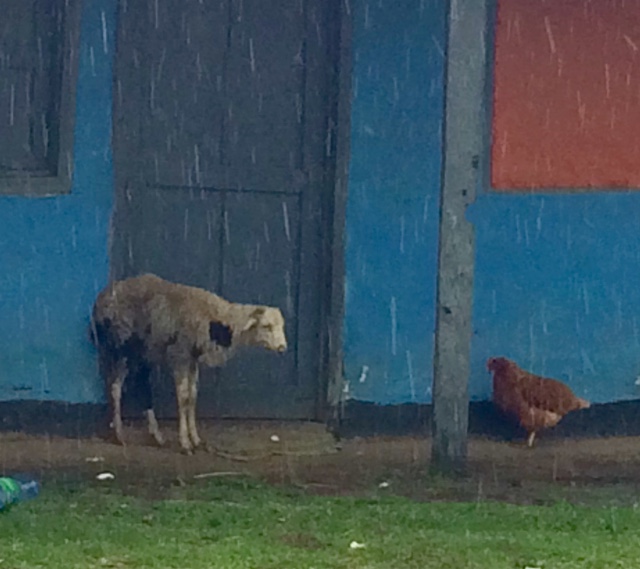
The pathetic little sheep and a chicken, waiting for the rain to pass. 

Monday, March 21, 2016

Ethiopian healthcare system as I understand it...

Ethiopia has a very well organized healthcare system. There are health centers and health posts - health centers are in the bigger towns and serve a certain catchment area. The health posts are in smaller villages within that catchment area. For example, at my future site there is a health center because it is the biggest town in its area and it serves 4 other smaller villages that each have health posts. The health center is where everyone in the catchment area comes when they are sick or if they need antenatal, delivery and postnatal care. (Pregnant women are encouraged to travel to their local health center for delivery rather than delivering at home, in an effort to improve maternal and infant mortality.) So the health center is staffed with nurses, midwives, a laboratory, a pharmacist, a cashier, they have a room for health records/registration, and someone doing health information management. Paperwork, record keeping, data collection and reporting is a big deal. (So it turns out there is no escaping it!) People pay for the care/treatment they receive when they receive it with the exception of perinatal care, family planning, vaccinations, etc; those services are free/covered by the govt. The health posts provide some treatment but they are more focused on illness prevention and health promotion. Each health post is ideally staffed with two health extension workers. HEW's complete some health training beyond high school and they are charged with making home visits to provide health teaching and outreach to their communities. So let's say it's a village of just 500 - that's still a lot of ground for 1 or 2 workers to cover! They have very nice educational materials (provided by the govt with international support) that cover a range of topics - nutrition, family planning, sanitation, hygiene, etc. There are families that readily adopt the HEW's health information and begin to practice health promoting behaviors so they become 'model families' - these model families are expected to share their knowledge and have a positive influence on their community as well. Each model family (they are actually part of what's called the 'health development army') is assigned 5 other families. It's a very organized, strategic approach for disseminating health information and encouraging behavior change in the community. 

There are private clinics in the bigger towns as well, so people can pay to go there when they are sick if they want. I presume it's more expensive. And of course there are hospitals in the bigger towns. Anything that the health center can't manage they will refer to the next level of care. 

Although I am a nurse, my role here is not to provide clinical care. There are plenty of qualified individuals who work at the health center and health posts - who know their community, are respected by their community, and will continue to serve their community long after my two years are up. My role is to support the work they are already doing, to assess the needs of the community and motivate the health center and health post staff to work with me on projects targeting the needs identified. I don't know yet what those projects will be! But it is my intention that they be relevant and of value to the community, that they have a long term vision and are sustainable, and that everyone has a voice and is part of the process. My first several months at site will be spent integrating into the community and completing a 'community needs assessment'. When I have enough information to start making plans I'm sure there will be a blog post about it!

This week we practiced building a pit latrine/squat toilet/mana fincanii/shint bet
It started out as just a hole in the ground, here it is almost finished - still needs a roof and wall covering of course. 
Proof that I contributed to the cause!
Our crew! I've spent a lot of time with these guys during training - I'll miss them when I move to site. 

Love from Ethiopia!

Tuesday, March 15, 2016

It's the little things


I can't manage to change it on the 'contact' page of this blog, but this is my address going forward. I can still receive mail at the Addis PO Box - but only if I know something has been sent there so then I know to go and pick it up when I happen to be in Addis. 
It's the little things... Like when I'm really looking forward to bathing and we have water! (We always have enough saved for drinking, cooking and hand washing but sometimes have to wait for the water to return before washing clothes etc.) Or the feeling when I first wake up in the morning and reach to turn on the light switch and it works! It's so nice to not have to get ready by flashlight. You never know when the electricity is going to be out. Luckily it's on more often than off. If it is the evening and the electricity returns you can hear the neighborhood give a collective cheer as their lights turn back on. A reminder that we are all in this together! 

One of my favorite meals so far was a heaping plate of green beans with carrots and cabbage with potatoes (atop the mandatory biddeena, of course). This country knows how to do vegetables right. 

And the not so little things... I have been feeling the love with the cards and packages I've received! I know it takes time, effort and hard earned money to send something across the globe to little old me. Your generosity, thoughtfulness and support is remarkable. And the emails, texts and phone calls (when I am able to get them) really keep me going especially when I'm having a "what am I doing here?" kind of day. How did I get so lucky to have such a great group of people in my life? I can feel the love from 8,000 miles away. Thanks a million! 

What I've been doing these past few months... During pre-service training our days are full - we are in "class" from 8 to 5:30 Monday thru Friday and Saturday mornings. Most of our time is spent in language and health classes. Health topics include: the Ethiopian healthcare system, nutrition, maternal child health, family planning, HIV/AIDS, malaria, behavior change communication, neglected tropical diseases (trachoma, schistosomiasis, soil transmitted helminths, onchocerciasis, lymphatic filariasis, podoconiosis, leishmaniasis & Guinea worm) & WASH (water, sanitation & hygiene). A few weeks ago I presented a brief health lesson to a 9th grade class at the secondary school here in town. And this week in small groups we hosted a community education event where we invited members of the community to learn about nutrition. Both went surprisingly well. Permagardening is another thing we learned about and practiced doing. I love the concept and find it interesting that I learned a lot about permagardening and saw it in action when I went to Cuba and now here I am potentially teaching it in Ethiopia. Who knew. 
Our classroom for health. 
Working on our permagarden. 

Still no access to email or most of the Internet for now. If/when it returns you'll know because I'll finally respond and also be able to make phone calls!

Love from Ethiopia!  

Wednesday, March 9, 2016

Uncomfortable bus rides, even more uncomfortable bus rides & horse carts

After a week of traveling and spending a few days at my future site (near Bale Mountains National Park), I'm coming back to training with a new perspective. Inchini feels like home now. Things that used to feel difficult or stressful here are now easy and no big deal. It was so nice to be welcomed back to town, I was really happy to see my host family and return to the comforts of 'home'. I know my site will eventually feel like this too, it will just take time. 

Traveling to and from site is no small feat. From Addis it's an 8 hour bus ride to the main town (including a 1/2 hour stop for lunch & bathroom break) and then an hour long bus ride to my rural village. The first bus ride is not that bad except it's 8 hours, with your bag on your lap, you're touching your neighbor and it's hot - in general, people are only willing to open the windows briefly so there is very little air circulation. The second bus ride leaves more to be desired. It's a very bumpy dirt road, the bus is jam packed so you have to push and squeeze yourself onto the bus, this time you are up close and personal with multiple neighbors while holding your bags. It turns out a person doesn't really need that much personal space. 

I ended up drinking so much buna during my site visit. In Inchini I had an established routine of one little cup everyday after lunch. But sharing buna together is an important part of building relationships so it's actually something I *have* to do. My second night of site visit I had just locked my door to go to bed when the landlady knocks on the door with a cup of buna with milk for me. No more than 2 minutes later here come the neighbor kids, their mother had sent them over with a cup of buna and some snacks! Of course I had to drink that cup too. While I would rather not drink any coffee before bed I had resigned to the fact that I would be drinking two cups, oh well. And this is on top of two cups earlier in the day - it would have been three but thank goodness I declined the first one offered after lunch. Then the landlady returns with the kettle of buna and milk and while I thought I was declining another cup it turns out the language barrier was in full effect because I ended up with a third cup of coffee. It was delicious but I don't want to make it a habit! Ethiopians are extremely generous. 

When it was time to return to Addis, I of course had to take the bus from my village to the neighboring main town where I would stay overnight and catch the 8 hr bus ride the next day. My counterpart and a nurse from the health center were also traveling to the neighboring town (to visit their families for the weekend) so we were going to catch the bus together. I was anxious to get going because I would be meeting some fellow trainees in the neighboring town and just wanted to get going on my journey. There was supposed to be a bus but if there aren't enough people then the bus won't go. So, there's no bus. Luckily my counterpart has a plan B. We can take a horse cart (garii) to the next closest village (5 km away) and maybe catch a bus from there. Maybe? 50-50 chance, he says. So we summon a horse cart. Horse carts are common in rural areas for transporting people and goods. It's literally a horse pulling a cart. So the three of us climb aboard with our belongings. There is room for 3 people to sit, the 'driver' has to sort of walk/jog alongside until the horse picks up speed and then he can sit on the edge of the cart/wheel well. I felt bad for the horse - it seemed like we were a heavy load. The horses and donkeys work very hard here. That garii ride is one I think I will not forget. It's the end of the day, at the end of a stressful week, we're riding across the Ethiopian countryside, mountains in the distance, and I'm sitting in the middle of a very spirited discussion between my future colleagues about the respective economies of Ethiopia and America. Is this real? How did I end up here? Sometimes I have to pinch myself. Shortly after we arrived in the next village there was a bus to take us to town, thankfully. But it was the fullest bus and most uncomfortable ride yet. I was just happy to be going where I needed to be. 
My first garii ride - from my new house to the health center. He just happened to be outside as we were leaving our compound and offered us a ride. This is my little town!
And here I am on a mule the day after I returned to Inchini. It was my host mother's idea and she would not take no for an answer. My favorite part of this picture is her laughing hysterically!


I am not able to access much online for now, the best way to reach me for the time being is WhatsApp.

Love from Ethiopia! 

Sunday, February 21, 2016

Tarii boru...

In a few days I will find out my site placement and then spend a week there to get acquainted. My host family is concerned about me going to a (more) rural area and not being as comfortable or having the things I need. My host mother is concerned about who will feed me especially since I don't know how to make injera (biddeena). I gently tried to remind her that for most of my life I have not eaten injera with my meals. I hope she is not planning to send me off with a week's supply! They have very sweetly said that they hope my site is close so they can check on me, if not they hope they happen to have relatives near my site so they can take care of me. 

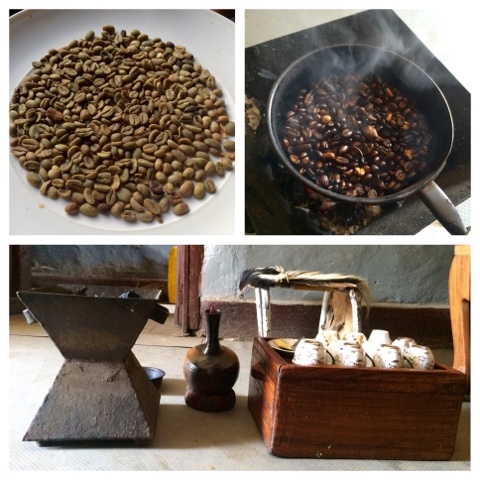
Yesterday I made buna (coffee). I think in one of previous posts I mentioned the important part buna plays in Ethiopian culture. My host parents have been asking me when I'm going to do it for awhile now but it's quite the process and the time just hasn't been right. It's become a joke in the family that I say "tarii boru" (maybe tomorrow) a lot. They ask if I'm going to make coffee after I've been in training all day - I say tarii boru... They really want me to eat a mango but I'm not quite sure my stomach is up for it - I say tarii boru... They really want me to drink a soda but I don't want one and they won't accept no for an answer - I say tarii boru...  Saying 'no' directly is not accepted but using 'maybe tomorrow' has worked well for me! So now whenever I try to say 'no' they say 'tarii boru' and we all laugh. Of course my host sister helped me make buna, I definitely wouldn't have been successful alone. First step is to get the charcoal stove going, next wash the green coffee beans and pick out any of them that are not good. Then roast the beans in a pan over the stove. There is a special way to shake the pan and toss the beans to ensure they roast evenly - I'm not good at it. The sound of the sizzling beans and of course the accompanying aroma is almost worth the effort. Next it's time to grind the beans, this is my favorite part! As you can see from the picture, it means smashing them by hand. A great way to get out any aggression. Then after heating water in the jebena (traditional clay kettle), add the ground coffee and let it steep for a bit. Finally ready to be served! Simply pour into the traditional cups (sini) with a hefty dose of sugar (even if you ask for a little, it's still a lot!). It tasted pretty good, but again I had a lot of guidance from my host mother and sister. 


I live across the street from a hair salon. It's just like you'd imagine. Several darling young women work there and throughout the day other women will stop by sometimes just to chat. Since its just across the street sometimes they call me over to hang out with them or if I'm on my way to or from class they will call out to greet me, I feel like a celebrity!

Last weekend we took a day trip to a resort in Sodere. It involved several hours on a bus but it was nice to see more of the country. It is along a river and there are a lot of monkeys there so that was fun.


Love from Ethiopia!

Monday, February 15, 2016

We are all different, we are all the same

When you are immersed in a culture different from the one you grew up in, you can't help but notice the differences everywhere. Some are more in your face than others. And then something happens that makes you remember that despite our differences we are the same too. A few days ago I learned my cousin died suddenly and unexpectedly. We're the same age. I was able to talk with my parents and was obviously upset but thought I would keep it to myself and not let on to my host family that anything was wrong. Of course my host mother knew something was wrong right away. I could communicate to her that someone had died but that was the extent of my language skills so my little 17yo sister came to fill in the blanks. She has an incredibly big heart inside her little body. She hugged me and cried with me and wiped my tears. Their concern for me is so genuine. They barely know me and don't know my family but of course they know grief and the pull to comfort others is universal. We are all different and yet we are all the same. I can't be close to my family back home right now but I am very well taken care of by my Ethiopian family. But it still feels strange to be far away during a time like this. 

Last week I received a surprise valentine card in the mail (thanks Mom!) and a package that I sent to myself with a lot of help from a dear friend who included a few extra treats - so delightful! 

And everyday I feel thankful for the beauty of my surroundings - the rolling hills with shades of green and brown and the way the sun filters through the clouds at the end of the day is pure magic. 


Love from Ethiopia!

Sunday, February 7, 2016

Biddeena making 101 and around the neighborhood...

Today one of my host sisters was making biddeena (injera in Amharic) so she let me watch and learn. (Photos shared with her permission) 
First she prepares the cooking surface by wiping it and coating it with some sort of ground fruit/nut to prevent the biddeena from sticking. Some people have electric injera makers, my family has the real deal. 
Next she expertly (and quickly) pours a measured amount of the teff (a local grain) and water mixture in a circle from the outside to the inside. It's harder than it looks, trust me. 
Then cover it and let it cook for a few minutes. My darling little sister! 
When it's done carefully remove it from the hot surface. My sister would critique nearly each one, telling me if it was too dry, too fat, or if the fire was too hot or cold. I, of course, couldn't tell the difference! But biddeena is a part of every meal so I can understand that it's important to get it right and its a point of pride to do it well.
And voila! Slowly the stack piled up. They tell me this is enough biddeena to last our family for 3 days - seems like a lot to me! Every 3 days they make more. Various vegetables and meats are served on top of a plate of biddeena and it is also used as the utensil to get your meal into your mouth. The darker ones on the bottom are made with a different kind of teff, supposedly more nutritious - and I can tell you it tastes more nutritious if you know what I mean. I prefer the biddeena you see on the top. Oh and the really ugly one on the very top is the one I made, pathetic! But of course my sister was gracious and told me I did a good job. It takes a lot of skill to do it right.
Here is the new baby lamb at our house (about 3 days old); a curious calf; one of about 4 chickens (I've enjoyed eggs for breakfast but there's been no chicken on the menu yet); and our guard dog (he looks slightly cute in this photo but don't let that fool you!)
Beautiful Oromia!

Ciao for now! 

Saturday, January 30, 2016

Home on the range

I am in a very beautiful, rural area in Ethiopia. I said I was looking forward to getting out of the city and now here I am in the sticks. The landscape is beautiful and I am getting used to this new way of life for now. My host family is wonderful! They are joyful and so kind, and they started teaching me the language right away.  The father usually holds a serious face but whenever we try to talk together in Oromifa his face brightens and he throws his head back with laughter - it makes me proud to have this effect on him. I have a 17yo sister - she's my girl! She's got the best English in the house so she has been super helpful. And she's sweet and adorable and seems fearless. The father is away most of the day working while the women and girls take care of the home. I have a 20yo sister and two 16yo female cousins who live here too. I can tell the 17yo sister was assigned to be my keeper so the others were not as quick to warm up to me but now we're all good - lots of laughing and joking, mostly laughing at me as I struggle with the language but I don't mind, it's all in good fun!  They all call me gobez (smart) but I think they're just humoring me. I am very well fed, I have not felt hungry since I got here, they always want me to eat more and more. While in Addis there are a lot of different types of food available, I actually ate a lot of pizza - because it was convenient and I knew that once we got out to the countryside it would be injera, injera, injera (bidena in Oromifa). And I have definitely been eating a lot of it. Meals are mostly traditional Ethiopian fare - injera with shiro (a smooth lentil stew) gomen (cooked greens - one of my favorites and the greens have so much flavor here!) alicha (potatoes, cabbage, and carrot) for example, but I've also had pasta with sauce, and eggs, bread and tea for breakfast.

My family has lots of animals - oxen, cows (2 babies), sheep (a baby should arrive while I'm here), horses, mules, donkeys, chickens, a cat, and a guard dog who is ferocious - he takes his job of protecting the other animals very seriously. To get to the latrine/squat toilet (mana fincanii in Oromifa, shint bet in Amharic) you hang a right where one of the cows and her calf are tied up, head to the back of the compound and you'll find it essentially inside of the hay barn. Of course at first I was a little uneasy but now I feel like a pro! And I now know it's actually quite nice as far as mana fincaniis go. Perspective. 

We are super busy with language and health training and there's not been time for much else. The days feel long and the nights feel short even though I go to bed by 9. It's getting dark by 6:30 so we're all inside by then because there are no outdoor lights. The stars are amazing - the sky is so full! 

In some parts of the area they are rationing water. The electricity, water, and telephone network are in and out. Internet is not available out here. When the 3G is working I can pay to use data for email, fb, and Viber etc. it just doesn't work consistently. This is my life for the next few years! I'll try to post some pics when I have time and the network is cooperating. 

Ciao for now! 

Wednesday, January 20, 2016

Ramblings...

Honking horns, excessive car exhaust, lots of pedestrian traffic, busy markets, and an impressive amount of new construction - Addis Ababa is your typical bustling capital city in a developing country. Maintaining a sharp appearance is important here so there is an industry for shoe shining - young men will set up their little stations on the sidewalk and men and women will sit down to get their shoes cleaned while out and about.

The other day we were taken on a brief bus tour of Addis. We went to the Entoto Mountain Forest area - it was cool to be up in the fresh air and see the city below. Lots of eucalyptus growing there - smells so good! Then we went to the National Museum of Ethiopia and saw some historical artifacts including the Lucy/Dinknesh exhibit. Pretty cool.

One afternoon when we had some free time a few of us fully embraced the minibus ("taxi") experience. A minibus is literally a mini bus that seats maybe 10 comfortably, it's a means of affordable public transportation between the neighborhoods. There is a driver, of course, and another young man who takes the fare (2-3 birr, about 10-15 cents in US $) who's job is also to yell out the window what neighborhood the bus is traveling to, so you know which bus to get on. Now I'm sure there are times when people do get to sit comfortably on the bus but it seems that is not the typical experience! Riding the minibus involves getting up close and personal, perhaps even sitting on a stranger's lap! There are crates placed on open floor space to make more seats. And, of course, if the person sitting to the inside of you needs to get off before your stop then a bunch of us need to get off in order to let that person off and then get back on again. Luckily the rides are pretty short between neighborhoods in Addis. There are private taxis but they are significantly more expensive and there are bigger buses and a new train/light rail as other public transportation options. 
It's been fun getting to know my peers, everyone is coming with different interests and backgrounds and has different skills to offer - it's really exciting to learn from them and be a part of this diverse group! 

So far I'm really glad that I brought my pillow from home (rolled it up in a space saver bag), my quick dry towels, and hand sanitizer. All of the restaurants have really nice sinks and soap for hand washing since we eat with our hands (well right hand, to be specific) but I'm glad to have hand sanitizer anyway.

Our first round of immunizations set me back a bit (for about a day) and I'll admit that when I wasn't feeling well I had some doubts about why I was even here and the thought of staying here for 2 years seemed especially daunting. But now that I'm feeling better I'm really happy to be here again! Knock on wood that the illnesses are few and far between. And whenever we have training sessions focused on our health projects my heart feels so full and 2 years doesn't seem long enough - so I know I just need to talk to someone about public health and community based work to feel better on those rough days too. Shout out to my public health peeps! 

Today is Timket, aka Epiphany which is celebrated by Ethiopian Orthodox Christians. So there are many traditional celebrations and ceremonies happening around the country. There was a procession that passed right near our hotel yesterday so that was interesting to observe. Again the road is closed nearby for more processions with singing, clapping and drumming. There are things being said and sung over megaphones that I don't yet understand. Lots of activity! Obviously a very important event for those celebrating.
I absolutely love that there is a huge flowering hibiscus tree near our balcony - I've never seen such a big one with so many flowers! 
Ciao for now!

Friday, January 15, 2016

It's all a blur...

Have been in Addis for a few days now - how many exactly? I'm not sure! We've forged right ahead into our training despite some serious jet lag, hence the past few days all being a blur. Finally starting to feel less foggy and having a more normal schedule. Our hotel is nice enough - hot showers, western toilets, has wifi that works off and on, and a rather eclectic decor! Our training is here on site so that's convenient. We've been well fed and they've provided LOTS of bottled water. Have been feeling well so far with the exception of exhaustion from jet lag in combination with the altitude. Started my malaria prophylaxis (Malarone - for those inquiring medical minds) so far so good. They also give us a really well stocked medical kit for if (when) we get sick so in addition to the stuff I brought I sorta feel like I'm carrying around a mini pharmacy - but the nurse in me needs to be prepared! We get the rest of the shots we need starting next week (again for those inquiring minds - typhoid, meningococcal and rabies). We leave for our home stays in about a week. I will live with a host family outside of Addis for the next few months while I continue training with my fellow health volunteers. I will learn next month what village I am assigned to - so far all I know is it will be small and rural (population of about 2,000) and most likely I will be the first Peace Corps volunteer they've ever had. Exciting! I will make a site visit there the beginning of March and move there in April. They've helped us set up our local phones so I can be in touch with everyone I need to be locally. Not sure how well I'll be able to communicate internationally from my village but there should be a bigger town nearby that will have things like an Internet cafe and post office (posta bet) so I can go there about once a week. 

Ciao for now! Or dehna hoon (goodbye) in Amharic.